Saturday, 25 November 2017

First Fortnight in Bangalore


He has 2 alphabets and 2 languages to learn before his sixth birthday
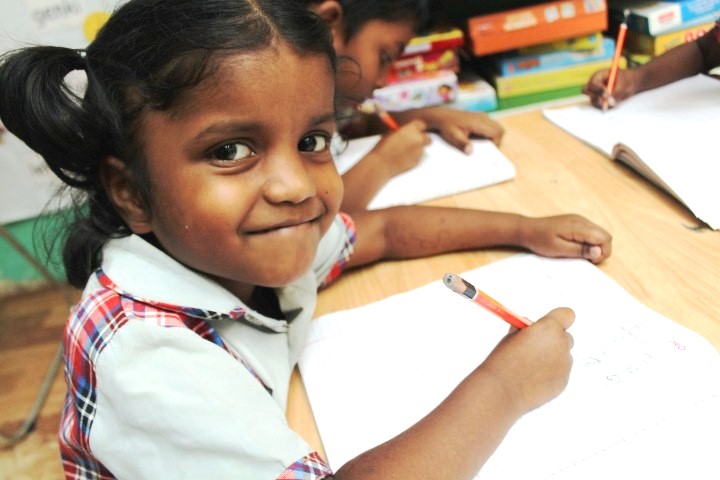
The children in Building Blocks Learning Centres look like average, bright and happy kids. The fact that there's no electricity or running water at home doesn't show in their behaviour,  and in their smart uniforms, they're pretty much indistinguishable from the kids who come from very different, financially privileged backgrounds. If he's smart, bright and hard-working when he's six, he'll be offered a place at an English-Medium School, and if we do our job at Escape from Poverty, he'll have a scholarship that will subsidise his fees and fund after-school coaching and mentoring right through to age 16.

Last week, someone suggested to me that it was a colonial legacy to "force the children to learn English rather than their own language," but this is a total misunderstanding of modern-day India.
In India today, there are more than 800 different languages. 122 are spoken by more than 10,000 people, and 30 of these are each spoken by more than a million. 
India recognises 31 official languages in which official business is conducted in India's 36 states and Union Territories.
Only Hindi and English are recognised as official national languages. English was to have been phased out in the 1960s, but this led to civil unrest and riots in the south of the country, where Hindi was not spoken. The government was persuaded to allow the continuing use of English as the alternative official national language, helping India to claim its place as a major economic power.
Numbers and Numerals in Kannada

For most of the children in Building Blocks, the regional language of Kannada is their mother tongue, but within a year at school they'll be proudly incorporating English words and singing English nursery rhymes. If you follow Building Blocks schools on Facebook, you might hear them wishing you a Merry Christmas and demanding "now bring us some Figgy Pudding," in a couple of weeks or so.

You might even catch the live broadcast on December 1st which we have named "Gratitude 2017" when I shall be interviewing some of the children and staff LIVE in our attempt at a global broadcast to thank our sponsors around the world. Don't worry - you needn't get up in the middle of the night to watch; we'll be posting an edited version a couple of days later.

The advanced technology of India never ceases to amaze me. 
Portable Wireless Hotspot
There are at least a billion mobile phones in India, and of these, over 300 million are smartphones, (the ones that do virtually everything.) 
I can use my UK phone in India free of charge through WhatsApp or Messenger because, in my pocket, I have a portable wifi hotspot smaller than my tiny Canon pocket camera. This amazing "Jio" cost about £12 and logs into ANY network in Bangalore, and I am assured it will work anywhere in India. In the New Year, I shall find out whether it works back home.
My point is that when you have a country with children who have the mental ability to juggle with languages in their infancy, and when you build a digital network that offers 12 weeks of unlimited text and calls, and 2Gb of data per day for a one-off charge of £6, you are creating a highly sophisticated, capable and interconnected workforce for the future. It's all about mental agility and technical dexterity.

Our challenge in Building Blocks and Escape from Poverty is not about qualifications and Exams, it's about self-confidence, people skills, leadership, and creativity. That's what James and I are talking about, as we put together the proposals to raise funding for a new school that will not focus primarily on rentable skills that can be sold by the hour. Artificial Intelligence will be doing that almost within our lifetime.
At our new school project, we envisage a community that will be totally child-centric and will value originality over conformity. Teenagers are perfectly capable of coming up with innovative solutions to what our generation see as insurmountable problems. They just need our encouragement. 
...And encouraging enthusiasm is much more fun than controlling ebullience.

If you'd like to contribute a few pounds to Escape from Poverty's General Scholarship Fund, you can make a sterling donation HERE using almost card which bears the Visa or Mastercard symbol.  We've put an initial target of £1,800, which is a 5-year scholarship, and already raised a third; I hope to set a higher target in a month or so.
If you make a donation, you'll be helping to change a child's life for ever.

Tuesday, 14 November 2017

Indian Children's Day 2017

Before they came to Building Blocks, 
these children would have been playing 
in the streets of the slum districts 
where they have their homes.


So much energy and enthusiasm!

In India, a national Children's Day is celebrated early in November every year. In Bangalore, there is great excitement with the children of Building Blocks pre-schools, who perform a concert for their classmates and invited guests including sponsors and other benefactors. As you can see from the video, they put all their effort and enthusiasm into their performance and it makes for a very entertaining day.

At Escape from Poverty, our focus is on the next ten years after pre-school, and a number of past students also participated in this year's entertainment.

These older children maintain their link with Building Blocks on such occasions, and more importantly through the After-School Programme

After they finish lessons at their new schools, they go back to their former learning centres, where they have help with coaching, mentoring and tuition to ensure that they do not fall behind the achievement level of pupils from more privileged backgrounds.

Click on the picture for more information on Escape from Poverty
From early childhood in absolute poverty in rudimentary living conditions, these children are now acquiring the skills, the knowledge and the self-confidence that will ensure that they will go on through their education, and  "Escape from Poverty."

Thursday, 2 November 2017

Heading for Heathrow

My travel memories on my office wall.
I monitor prices for the photo-printing company www.my-picture.co.uk, and every so often, the price of 40cm x 30cm canvas prints drops from thirty-something pounds to around a tenner, and that's when I add another one or two travel memories to my bedroom wall. There are many memories already on display: an open gateway at a retreat centre in Wales, the tram lines going into the Berlin Wall 3 months after it went up; teenage girls on the beach in France, and a memorable lunch in the sun near Carcassonne earlier this year.

In the coming weeks, my camera will come into service again when I start on a new fund-raising project to support my charity, Escape from Poverty. I am copying the idea of  Khora, one of the refugee organisations I came across when I was in Greece last year. 
Volunteers at the Khora community centre in Athens

They produced an artistic photo-book which they sold to raise funds. 

Inspired by this, I am working on a commercial project to fund the design and production of a full colour "coffee-table book" illustrating the life of children in Bangalore, and the educational projects supported by my charity. This book will then be offered for sale to raise funds for scholarships.

My son-in-law has given me his Nikon digital SLR now that he has upgraded to something even more technically complicated, and although my pocket Canon and my mobile phone take good pictures, I look forward to getting my hands on a real camera again.
One week from now I shall be (in sh'Allah) at LHR T5, nervously wondering if I have packed everything. 


An invitation to the party
My trip includes the Indian Children's Day Festival on November 11th, then a fortnight in Bangalore, planning the 2018 marketing strategy, and setting up organisational procedures before I fly off for a side-trip to Mumbai to see the projects of Aarti Naik with girls' education in slum districts around the city.
The chapel/temple at Shantivanam
Back briefly to Bangalore, and then I'll take the night train for the 8-hour journey to the monastery/ashram where I shall spend Christmas and New Year.

If you are on the mailing list for the Escape from Poverty newsletter, you will receive an email link to this blog each time I add a new post.
This blog is also promoted on my Facebook page. 

Please feel free to share widely. 

You can support Escape from Poverty here: MyDonate.


Monday, 10 April 2017

Education is the Escape from Poverty

Just one year ago, I visited the deprived slum districts of Bangalore (Bengaluru). I had been invited to see the "Building Blocks" Learning Centres that had been established by an idealistic educationalist, James Suresh Ambat. 
Smart young children learning their numbers and tables

These Building Blocks pre-schools are mainly funded by businesses and wealthy local individuals, with support from organisations like Indian branches of Rotary and Lions Club.

When I saw the organisation and the vibrant enthusiasm of both the children and the teachers, I was seriously impressed. These youngsters now take a pride in their appearance, and their self-esteem has blossomed. By the time they are six years old, these children from impoverished and deprived slum neighbourhoods, are numerate and literate in both the local Kanada language and English, making them potential candidates for the English-medium educational sector. 

However, such further schools are fee-paying, and when James Ambat described the scale of his operation and the challenges they face, I asked whether there was a fund-raising operation in the UK. When he said "No," I asked if I could set one up.

It has taken a year to find a suitable charitable trust, and with the help of a friend I tracked down one in Devon who were interested in working with me. Earlier this month, the Charity Commissioners allowed the setting up of Escape from Poverty with all the benefits of charitable status, which will facilitate a 25% increase in the value of donations from UK resident tax-payers through the Gift Aid system.

Sponsoring a child for school fees and the after-school coaching and tuition groups costs less than a pound a day (£360 per year,) and as soon as the new charity's bank account is open, I shall be launching the crowd-funding for two sponsored scholarships. 
These will support two siblings, Krishnakanth and Keerthi. 
Krishankath and Keerthi with their mother
My target is to fully-fund and pre-pay their 10-year scholarships in the course of this current year. Once my friends and other donors have helped to achieve this, we shall seek out two more children to sponsor in the future. 
Of course, individuals or families or groups can choose to sponsor a child themselves, - which is what I did last year. Chaitra has glowing school reports. She sent me a touching birthday card, and already one friend here in the UK has now also decided to sponsor a young girl for her next ten years of education.

More details of Escape from Poverty once the new charity website is up and running. 


Everyone who is on my newsletter mailing list will receive regular newsletters from Building Blocks and you can opt out any time, with a click of the mouse on the "unsubscribe" line below.

Wednesday, 16 November 2016

A Song and Dance Routine


The children arrive for the concert in a school "crocodile" Indian-style
Yesterday was Children's Day for the children and friends of Building Blocks pre-schools in Bangalore. It was a day filled with joy, and celebrated with all seven pre-schools from around the city, coming together for a performance.


The concert began with the traditional lighting of the oil-lamp.

Here four young dancers are helped by three of their teachers.

The pre-schools have classes of around 20-30 pupils, and all have qualified teachers.
Sometimes, the teachers have training days when they visit some of the expensive schools in middle-class areas, so they can study teaching practices and observe different techniques.


The show took place in an outdoor auditorium in a beautifully planted park in Bangalore. 


The children were bussed in from their schools, which are all situated adjacent to seriously deprived residential areas.


James Suresh Ambat, the founder of Building Blocks was hauled up on stage to join in one of the performances - much to the delight of the children, who roared with delight as he showed them how it should be done.


It's all very different from the Sir Roger de Coverley English Country Dance that we had to perform at my Junior school on the occasion of the coronation in 1953.
I was called up on stage to talk about the "Plus Ten" scholarship project.
The little girl beside me is Chaitra. I have sponsored the next ten years of her schooling


At the end of the show, James commented to me:"They just don't look like a bunch of slum kids, do they?"

As I reflected on this later, I realised that this is the whole point of James' work - and what led to my involvement to set up the charity in the UK.


If you teach children hygiene and nutrition, give them a school uniform so they look like all the other children in school, then, with a good education, they have the opportunity to escape the poverty trap. 
A sponsored scholarship costs £3k or £25 per month for ten years. No, I know what you're thinking, and I can't afford it either. More to the point, I cannot not find that amount to really change the life of someone who was born into an underprivileged environment. It's up to her, now, to work hard and realise her potential.
Keep following the blog and there will be information on UK-based fund-raising early in the New Year.

Tuesday, 25 October 2016

My Next Challenge

Helping slum children to escape from poverty

Children from one of the "Building Blocks" group of free schools
for children living in the slums of Bangalore
Earlier this year I wrote about my visit to India, to Bangalore in the state of Karnataka, to the group of "Building Blocks" schools founded by James Ambat with his wife Hilda. You can read the story of my visit by clicking here.

Building Blocks has 7 schools, a staff of almost 80 teachers and helps around 700 children aged between three and six with a grounding in speaking and writing the English language and with core subjects like arithmetic and general knowledge. The purpose of starting English at such a young age is that English is the teaching medium in all the better schools right throughout India. 
The Kannada language has its own distinct script
The local vernacular language of Kannada is spoken by 51 million people in and around Karnataka, but this figure represents less than 5% of the population of India. 
The actual number of mother-tongue languages spoken in India is 1,652 and Kannada is one of India’s 22 distinct official languages, each with their own script.
The original proposal in the Indian constitution was that Hindi and English should jointly be the national languages of India for a period of 15 years from 1950 to 1965, after which the national language would be Hindi. However, when English was dropped, in January 1965, there was civil unrest in South India, and within a month English was reinstated as a national language alongside Hindi.

A country with so much diversity was simply not able to establish the Hindi language, which is spoken predominantly in North India, as its universal tongue. The benefit of this situation has been that Indians have a comparative edge over the citizens of many other countries because of the wide-spread use of English. As a result, educated Indians with basic skills and qualifications are able to seek employment almost anywhere in the world. Today, English is the chief language in the Indian education system, and while many infant schools teach in the local vernacular, English is the teaching medium for better schools through all age-groups.


The Challenge of Poverty


A Bangalore slum district

According to official statistics from the Karnataka Slum Development Board, the state has 2,796 slums housing over 4 million people. 
With the expansion of Bangalore, the slums have also increased, taking the official number of slum areas from 473 in 2003 to 597 in 2013. Officials say over 16% of the city’s population live in slums, but some experts put the figure much higher, at between 25% and 35%.
The urban poor are living on government, private and railway lands. Most slum dwellers work as drivers, domestic helpers, cooks, construction labourers, fruit and vegetable vendors and night watchmen. If there is to be any escape from this poverty, it must start in childhood

Much of a baby’s physical development is determined in its early weeks and months of growth, and much of an individual's intellectual development is similarly determined in their early weeks and months of schooling. 


Learning how to learn, and becoming familiar with language and communication skills, as well as basic literacy and numeracy, will equip children for continuing years of quality education that will set them up for a good life in adulthood.


Building Blocks gives 3-year-old children from impoverished backgrounds a high-quality start to their education.
In the seven schools currently run by Building Blocks, they learn Reading, Writing, Arithmetic, English and General Knowledge right through from admission till they enter mainstream education at the age of six.


The education is free of cost for these slum children who are provided with the best educational tools to learn.
‘At present, the school caters for children between the ages of 3 to 6. 
After a couple of years of schooling, we aim to get the children into good English-medium schools with the help of our sponsors.’
The children have a healthy, nutritious meal every day

Escaping from the poverty trap


The core principle behind Building Blocks is the belief that if underprivileged children have access to free education, meals and medical care, they can escape from slum existence and build a better life. Through Building Blocks, the children have excellent English-medium schooling for the first 2 years of their education. Then the scheme creates new challenges when they move on from pre-school after a celebration at their graduation ceremony.
Graduation Day at one of the Building Blocks schools
Placing children in primary schools with similarly high standards compared to the teaching they have received in their first two years learning with Building Blocks, requires scholarship funding. Hence Building Blocks' "Project+Ten," which sets out to raise sponsorships and scholarships to cover the next 10 years of a child's education.

When they move on, their new schools can be challenging, and some of these children need coaching and mentoring to ensure that they can keep up with children who come from less deprived family backgrounds. To address this, the team at Building Blocks supplies free afternoon coaching and tuition to children who have progressed from their pre-school and have now been sponsored into primary and secondary English-medium schooling. A scholarship to support a child for ten years, once they complete their time at pre-school costs approximately £3,000 including after-school coaching and mentoring. 
The visionary educationalist, behind Building Blocks
I was so impressed by what I saw in Bangalore that I returned to England determined to set up a fund-raising operation to support Building Blocks.

I located a UK-based charity that operates in the field of education in India, and we have come to an agreement whereby donations can be channelled through this charity to enable Gift Aid to be reclaimed.

My next step is to fly to Bangalore on November 1st and spend 2 weeks working on the practical organisation. 
I also want to ensure a good flow of information and promotional material.

But I cannot do this single-handedly 


I hate to admit that I am not as young as I used to be, but that is a simple fact. I need a team of volunteers, ideally located around the East Midlands, who will work with me and carry this on into the future. 
There are exciting challenges for people who are interested in coming together to develop and implement an effective strategy, both to support the pre-schools and to develop sponsorships for Project +10. For the moment I am funding the initial costs through my work in management training, and I have pledged my personal funding in Project +10 by sponsoring Chaitra, who graduated from Building Blocks' Azalea pre-school  earlier this year. 
Last Spring, I spent three months in Greece, working with volunteers confronted with the effects of the refugee crisis. That crisis continues. I am still involved with groups concerned with integrating refugees into British society and giving them the opportunity to build a better life.
The objective of my work in India is also about giving people a better life by creating new opportunities. You can follow the story here, and if you are interested in working with me to get the UK operation up and running, please contact me at mail@bobharvey.co.uk.

Tuesday, 23 August 2016

Postscript, after 6 weeks back home

There are refugees and there are migrants.
  • There are refugees fleeing from war, violence and devastation.
  • There are migrants fleeing from poverty, oppression and lack of opportunity

However you label them, they have one thing in common: they are people in search of a dream of a better life, who have found themselves stuck in a nightmare.

After university, I worked as an expatriate in Africa, to improve my work prospects and put cash in the bank. That’s on a different scale from what today’s economic migrants are doing, but it’s the same in principle. The difference today is in the direction of the flow, and the scale of the human traffic

Migration on a massive scale is a problem that is not going to go away. By Christmas, there will be roughly ten thousand, mostly African, migrants in Calais. They have crossed the Sahara to reach Libya before making the perilous crossing to Italy.

Burial of migrant in the desert
Thousands of their compatriots have perished on the way, dying from thirst, hunger and exhaustion in the desert or drowned at sea.
They reach France and sleep on pavements in Paris and along the embankments of the Seine. Others head to Calais and blend into the shanty town known as The Jungle. Some are rounded up by the French authorities and relocated to detention centres. The authorities show very little humanity towards these desperate nomads, mostly men, who seek only to escape the grinding poverty and persecution of life in Africa.  They have risked their lives and racked up massive debts to fund their migration. They are desperate, and desperate people will take extreme risks to achieve their objective.

Migrants who reach Greece are mainly refugees from civil wars and terrorist activities in Syria, Iraq and Afghanistan. While the migrants in France are mainly young men, the refugees in Greece are mostly family groups and unaccompanied children. In order to protect its tourist industry, the Greek government has taken great steps to hide the 57,000 refugees that are scattered across the islands and the mainland.

Refugee accommodation
at a detention centre in Northern Greece
There has been an extensive clean-up campaign in which refugees have been herded into detention centres, administered by the military: anything from tents in fields to crowded accommodation in disused warehouses or large marquees.
In some centres, there are volunteer groups, who strive valiantly to create some sort of infrastructure and activities with playgroups, schooling, language classes and women’s groups. The government’s contribution is to manage the establishments in the style of prison camps, with little more concern than a farmer might have for livestock.

These are real people, real lives, real histories and real futures.

From my own experience, I know that many of these refugees are highly qualified, professional individuals whose homes and livelihoods have been bombed to rubble. They cannot “Go Home,” – because home no longer exists, and will not be rebuilt in a generation.
Here in Northern Europe, it is pointless to imagine that the immigrant crisis is going to fade away like an English summer. These are real people, real lives, real histories and real futures. So, how will we cope with the inevitable invasion that will happen when the refugees and migrants finally cross borders and become part of our community?

I support various organisations under the banner: “Refugees Welcome Here!”

Asian exiles land at London Stansted after being expelled
from Uganda by President Idi Amin in 1972

Part of my motivation stems from having seen the regeneration of the English Midlands that resulted from the mass immigration of Indian-origin Asians from East Africa at the time of Uganda’s president Idi Amin. 

That influx changed the face of Britain with an explosion of entrepreneurial flair across many industries – to say nothing of the rejuvenation of convenience stores and the salvation of many rural post offices. 

Today, we see the children of that generation in senior positions in our health service, in the City financial sector and in the legal system.
Winners of the UK Asian Professional Awards in 2015
We now have to choose not only how we face the challenge that faces us from the pavements of Paris and the mud of the Calais camps; we have to decide how we will handle this as it continues through the rest of this century. We are all going to have to step outside our comfort zone and interact with an ongoing influx.

Love changes everything
This will only be achieved through a Hearts and Minds campaign. You can legislate against discrimination and incitement to violence, but you cannot change legislate to change attitudes. 

There are seeds of hope in some statistics. The UK census in 2011 established that 10% of all live-in relationships cross ethnic boundaries, and there is every reason to predict that this proportion has increased since then and will continue into the future.

Most of the next generation has far less racial prejudice than its parents and grandparents, partly encouraged by the multi-ethnic nature of popular culture.

Today, Britain is an island in name only.


We have the choice between living in the resentment and divisiveness of the past, or welcoming and integrating people who want to create a better life for themselves and their offspring, and will both contribute and enrich our society.

We have the choice between living in the European dream or living in permanent fear of an imaginary nightmare.

The invasion will happen . . .

The reality will not change: the invasion will happen over the next few years. The only realistic response is positivity, compassion and love, and what we project will determine what we receive in return.
The sign on a structure in The Jungle in Calais reads
“We are searching for a better life.”