|
Wednesday, 8 May 2019
Graduation Newsletter from India
Tuesday, 7 May 2019
International Convention of Peacemakers
An intriguing invitation
![]() |
| The convention website at http://peace-con.org/ |
In January, I received an invitation to an event in Kathmandu.
The event sounded rather weird and wonderful, entitled International Convention of Peacemakers for Universal Harmony, and the organisation described itself as a platform to bring together intellectuals across the world, who are the well-wishers and practitioners of humanity.
I was intrigued and read more at http://peace-con.org/ The invitation came from a doctor I had met and chatted with at an ashram near Bangalore last year. I was apprehensive, but never being one to turn down an excuse to travel, I blocked the dates on the calendar and booked my flights.
![]() |
| The Valley of Kathmandu |
The conference content was eclectic. I cringed at the music videos, which reminded me of the personal development and multi-level marketing seminars I dabbled with in the 90's.
I was bewildered when the sticking-points of the discussion groups were laid at the feet of the white-clad guru who would then deliver his enlightenment, and I struggled to understand some of the broken English that is the lingua franca throughout South Asia.
Learning to accept the unconventional and seemingly unlikely
To be honest, I struggled with some of the mood and terminology of the event. I had to learn the meaning of duality and non-duality, which I initially found most confusing. I had to grapple with the deeper concepts that the organisation envisioned behind Humanity and Nature, and I had to accept the possibility that Science had diverted us away from deeper truths that Society had rejected as superstition over the centuries and millennia.
What was unsettling was to discover that this resurrected knowledge was endorsed by clear evidence in the results of the organisation's innovations in both Health and Agriculture.
Farmers who eliminated chemical fertilisers and pesticides saw increases in crop yields within two seasons,. Medical conditions that resisted modern medication were alleviated by unusual treatments, including the mystery of Sound Therapy.
Being one of only three delegates from outside the region, the others being a young Japanese businessman and a retired American academic living in Sri Lanka, I was treated with unearned reverence. I was also asked to deliver a brief opening and closing address for the event.
The messages of the programme demanded a leap of faith that challenged even an ageing bearded hippy like me. When they asked me to speak at the opening session, I had no idea what to expect over the next days, and this is what I said:
The central themes of this
convention are Equality, Unity and Prosperity. These words will mean different
things to different people, and I have the privilege of being asked to be the Voice of the UK
So, what is the Voice of the United Kingdom – or any country?
The voice is not what a country says:
it is what a country does.
The message is in their actions.
·
It’s in the way they
treat the poorest members of their community, and their children and their
elderly.
·
It’s the way they relate
to their neighbours . . . and whether they acknowledge that we are all
neighbours in this global village.
·
However, the present
Voice of the UK is not Unity, nor is it Connection or Love. The voice of the UK
says Separation
Three years ago, the British people
voted against continuing to be part of a United Europe. It was a close vote,
and the electioneering process was corrupt but, by a narrow majority, the UK voted
to leave the EU.
There were extreme attitudes
affecting many of those who voted to leave, but behind these extremes was one
common thread: British people felt that
they had lost the “Voice of the UK.”
Perhaps the central and most
significant motivation was that a majority of voters did not want people, whom
they saw as foreigners, influencing
British politics, even though by leaving the EU, the UK would cease to influence
the politics of the continent of Europe, of which Britain is part.
Millions of British people voted to
Leave because they did not identify as Europeans. They wanted to be British,
but they no longer had any clear idea of what this meant.
They were losing their identity, –
like thousands of the tribes of the world who are swamped by global culture, with
a global identity that in no way represents them nor their communal traditions.
What is it
that unites people and gives them their identity when everything conspires to
divide us?
We are
divided by 6,500 spoken languages.
Even a country with a common
language, is divided by dialect and accent, and the national language is often not the mother tongue of a significant
proportion of a country’s population.
Identity is generally drawn from
history, tradition and heritage, but rather than looking backwards, might it
not be better if a country staked its identity in limbo, half-way between the
present, and where it seeks to be in the future?
This would be a fluid,
self-regulating identity that bends with the wind and matures with time. An
identity with a one-word definition: HUMAN,
and a single culture: HUMANITY.
Communication is not about what you
say, it’s about what the other party hears. It’s not a matter of what you
mean, it’s a matter of what the other person thinks you mean.
Painful misunderstandings are easy
when one or both of you are communicating in a language other than their mother
tongue.
When we communicate with words, the
other person’s brain has to translate and ascribe a meaning – an emotion – a
sentiment to those words.
And all too often, the meaning is lost in translation.
We need to communicate our message
of Equality, Unity and Prosperity through our actions.
·
Not with noisy words,
but with silent actions.
-and we
can go one layer deeper. . .
o Not by doing, but by being.
People
will not change the world when they change what they say; they will change the
world when they change what they do.
Oh yes! -
of course there is a time for words, - like now, at a convention, perhaps.
But in a
world that is deafened by words and languages, actions will always speak
louder.
We will
not achieve Peace through words . .
.
Whether we speak them,
Sing them, or
Chant them.
Whether we write them
in documents,
Carve them in stone,
or
Scrawl them in
graffiti on walls.
We must
act, from a position of love, connecting, and leading by example.
Doing
nothing is not an option.
We will only
make a difference by being the difference.
Saturday, 13 April 2019
10 - Year Plan
The Zinnia Project
I was looking at the timescale for the Zinnia Project here in Bangalore.
We want to build a school, for ages right through from 3 to 18. Our pre-schools are
named alphabetically after flowers, Azalea, Bluebell, Carnation and so forth. I
decided that our schools for a wider age-group should keep the tradition, but
start at the other end of the alphabet hence, The Zinnia Project.
A school that will reveal children’s
strengths, rather than uncover their weaknesses.
A school where talents are discovered,
developed and valued.
It will be a school that acknowledges that every positive passion has
value, and where every child discovers that what you can contribute to the
world, is more important than what you can take out of it.
Like our pre-schools, Zinnia will take innocent young infants, coming
from illiterate families, who live in the humblest, impoverished homes, in the
slums of Bangalore.
School fees will start at zero, and only start as and when the family feel that they can afford a modest contribution. In years to come, when our students are
earning and enjoying a lifestyle their family never thought possible, these alumni of our projects will
be encouraged to fund scholarships that will help to educate the next
generation.
It is an exciting dream, but a dream without a timescale can never
become reality, so I was sketching out a plan, and putting dates along the
timeline.
![]() |
| I got as far as finding a timeline template |
This was when I realised that the plan will evolve slowly, and even
Phase One will take us up to 2024. In 2030 we might see our first students
entering University, and if I live to see a Building Blocks student graduate
from University, I shall be 90 years old.
Maybe, by then, I shall be retired, but I shall never lose my
involvement in the amazing challenges of education. You can only change the
world through education, just one child at a time.
It’s all about the strength of an individual, and the power of refusing
to let yourself be put in a box and told all the things you cannot do. I remember the mood of the 60’s,
when my generation’s self-belief was off-the-scale. The pungent memories of World
War 2 had a declining influence, and started be part of the history of a
previous generation.
![]() |
| I had an unforgettable year working with youth theatre in Nairobi in the 60's |
The Liverpool Beat of the Mersey Sound, heralded a teenage revolution of self-confidence.
Today I see this same teenage energy reflected in the youth of the townships of
the Third World, where only the older generation remember colonialism.
These teenagers are succeeding because nobody has told them they can't–
just like our 5-year-old heroes at Building Blocks.
It was just the same along with my fellow VSO
volunteer, when we were working with teenagers our own age in a theatre club in Nairobi
in 1963.
Since I am now 75, it is unlikely that I shall see the Zinnia project
completed, and that is a very sobering thought.
But, at the same time, it is also exciting, to reflect on the fact that this
dream will live on. The little toddlers who screech with excitement when I walk
in to their classroom at Building Blocks today, may well pass through Zinnia
and then grow into strong and purposeful adults who can be an example to the next
generation.
If a small cohort can inspire their peers to focus on others, and not be
obsessed with the frivolity of materialistic consumerism, they will change the
world.
I always remember the wise words of the anthropologist, Margaret Mead:
Never doubt that a small group of thoughtful, committed citizens can
change the world; indeed, it's the only thing that ever has.
Tuesday, 26 February 2019
Hogmanay, Valentine's, and a Special Birthday!
. . . and courting the big donors, too.
I find it strange to think that next week, I will have been here 6 months.
So much has happened, and life races on with new jobs on the list every day.
There was all the initial apprehension about finding somewhere to live, but James and Hilda found me this wonderful house where I live in a spacious, 3-bedroom, ground-floor apartment.
It's well within my budget, despite the automatic annual rent increase, and it's located in a quiet side-road with friendly neighbours occupying the other apartments in the building.
I have had to learn how the utilities are charged and paid for, the location of the best bakery, and which are the most reliable fruit and vegetable vendors. I still have struggles with the peculiarities of Indian online banking, the mechanics of ordering take-aways using those tiny buttons on my phone, and the endless requirements for an OTP (one-time password) whenever I attempt anything online.
I am kept busy with a steady flow of proposal documents, and spend most of my time on keyboard and screen, and I love this. When I was cold-calling for a double-glazing company after my restaurant closed down, I judged my success by whether the person I called thanked me for calling: it all came down to how I approached the prospect, and I still feel the same way now, in India.
Fund-raising is not dissimilar. I never view fund-raising as a begging-bowl. To me, it is inviting people to the opportunity to be part of the solution to a problem; an invitation that can be welcomed and experienced as enriching.
![]() |
| Indian businesses take CSR seriously |
I love the fact that companies in India are required by law to donate 2% of their profits to charity. I warm to the glow on the faces of corporate volunteers who come to visit the schools, or to run projects like an excursion for a group of our kids to go to a museum, or to organise a school Sports Day. Corporate Social Responsibility in India is so much more than a legal requirement; last week I heard CSR described as Compassionate Social responsibility.
I have just finished a proposal for a consortium in Silicon Valley, made up of like-minded philanthropists who have made their fortunes in I.T and are looking for schemes that they can support. We are seeking funding for a Primary/Secondary school project with a radical curriculum that seeks to foster creative thinking from an early age, to face up to the challenges of Artificial Intelligence. The philanthropists are excited and I too am excited.
![]() |
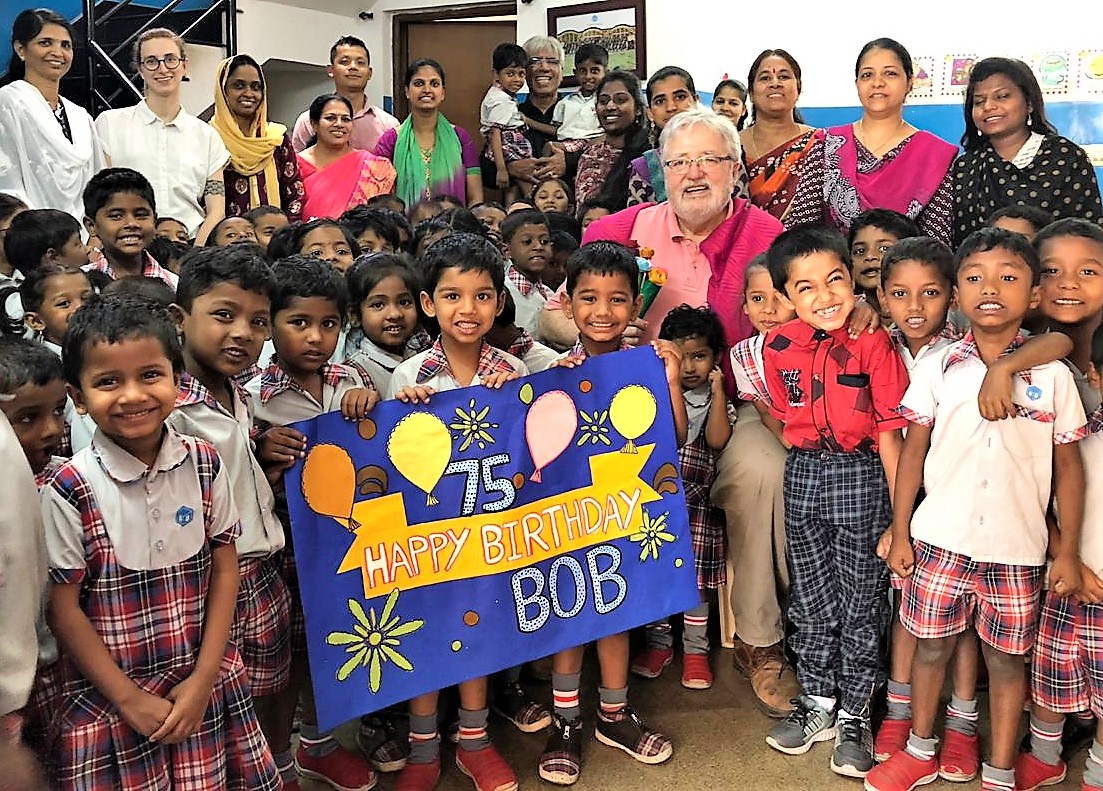
| They made me a birthday card |
I know that there are many people back home in England who feel jealous of the opportunity that I - at 75 - have in being involved in such an innovative project. The rewards are sometimes very emotional and overwhelming.
My birthday brought home to me the 2-way emotional involvement I am experiencing here in Bangalore.
I love these positive, dynamic kids, and the affection is mutual.![]() |
| Such lovely people, the dedicated staff and the positive, determined children. |
I set up a Birthday Scholarship Fund for my 75th, and it looks as if it could pass £1,000.
If you'd like to nudge the total upwards (every fiver helps,) click on the link and pay with VISA or Mastercard, Debit or Credit cards, - and thanks from all of us; we all appreciate it!
![]() |
| https://mydonate.bt.com/fundraisers/bobharvey |
Tuesday, 1 January 2019
New Year newsletter from all the team in Bangalore
| |||||||||||||||||||||||||||||||||||||||||||
|
Subscribe to:
Posts (Atom)