Thursday, 9 June 2016

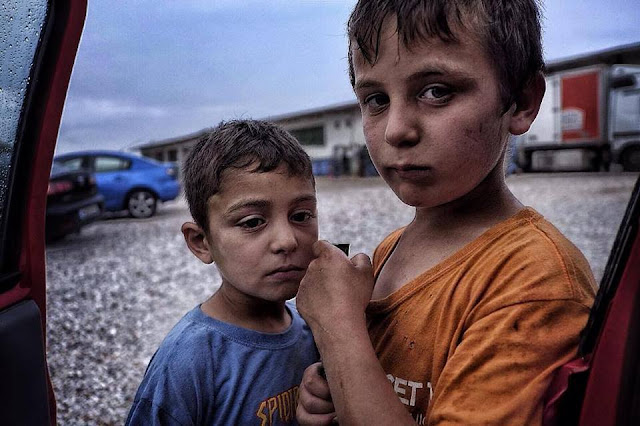
We are their jailers: What is their crime?


They have committed no crime. 
They can no longer live safely in their home countries 
and they are searching for a new life. 

I posted these pictures on Facebook recently and there was an immediate reaction, and they were “shared” many times. I don’t think many people realise the size of the problem.

I want to write about the "camps" where refugees are now effectively incarcerated. Not the squats administered by the Anarchist Solidarity movements with education for the children and language classes for all, but the government internment camps where refugees have inadequate food or drinking water, erratic electricity supplies, inadequate sanitation and limited healthcare.

I have tried all day, but I am overwhelmed with sadness, anger and feeling impotent to make any meaningful intervention. 

People in such camps need to establish and prove their status as refugees seeking asylum from the conflict in their home countries. Let me try to outline the processing system, as I understand it. The first stage is to apply for asylum in Greece. If this is granted, it will then enable the refugee to proceed to other EU countries (most refugees want to settle in Northern Europe.)

The asylum application process is by live interview via a SKYPE (video-call) link. The officials are mostly Greek but may be from other EU countries. There is limited availability of interpreters to participate in these interviews; some languages are available for two or three hours per day, others are available just once per week. 

Remember that there are over 50,000 refugees seeking asylum each one needing to start their application by going through the Skype interview and application process. If you do the sums, you can see that this could take years, - even if everyone was fluent in a common language. 
A Greek and a Syrian speaking second-language English to each other is not a formula for the reliable communication of accurate information. That’s not any kind of criticism, just a realistic observation.
Then there’s a lot of misunderstanding about smartphones and Wi-Fi. Back in the UK, many of us think of internet access as something of a luxury that provides easy access to emails and entertainment. For refugees, it is an absolute lifeline. There are very few “internet cafes” now that a majority people have access to the internet in their pocket. If you don’t believe that, travel in India and you’ll see how the world works these days. Everyone has a smartphone and top-ups can cost just pennies

This is why refugees need to own a smartphone to access the internet through a Wi-Fi hotspot. The internet is the prime source of any information about immigration, residence, and every other aspect of relocating to a new country. It is also the only way they can keep in touch with family, friends and relations whether back in their home country or elsewhere in Europe. 
I find it very difficult to imagine the absolute cruelty of police and army who have been known to confiscate phones when they move refugees to new locations.

Plenty of fresh food for lunch at the Plaza
You may have seen video footage of holiday resorts and tourist hotels that have been converted to refugee accommodation. 
The Plaza Hotel in Athens has often featured, but you need to know that this is not a government enterprise. The Plaza is a model operation with classes and activities for everyone. It is run on philanthropic lines with great care and democracy by the Athens-based anarchist Solidarity movement.

Camps run by the Greek army tend to be less generous and philanthropic in their management, partly because the Greeks are restricted in what they are able to provide. The EU is telling the Greeks to provide bed and board, but is not providing anything like sufficient funding for the Greek government to be able to do a proper job.

When the camps started to be occupied, whether on the islands or the mainland, very few had all the basics in place.  Water, sanitation, and electricity have rarely been available in adequate supply. The insufficient provision of food is disgraceful, and drinking water is often rationed to one litre per person per day – which is half the recommended consumption for temperate climates – not the 40+ sunshine of the Greek summer. 

More information is all over the internet. Here is a typical story 
 Here is a typical story

No, please don’t shrug your shoulders, because there are things you can do. For a start, you can talk to your Town Hall, and get them to declare a clear policy on Refugees. 

Then you can approach the Faith leaders in your community about promoting the idea of “Refugees are Welcome Here.” By Faith leaders, I mean not only priests, ministers, pastors, rabbis, and imams, I mean the hierarchy above them who need to feel pressure coming up from the grass roots level.

We are not getting the leadership the country needs from the Archbishops of Canterbury and York, nor from the Chief Rabbi, nor from the heads of the Muslim, Sikh and Hindu communities. 

We are not getting leadership from the TUC or the CBI and we are not getting it from any political party. I have lost faith in Westminster!
  • Westminster no longer represents the people, and we are looking for an honest alternative.
  • Maybe they should start worrying about that.

Friday, 3 June 2016

The Volunteers

People Who Come Out as Volunteers

I had a message this week from someone called Alan, who wanted to know how he could get involved with a volunteer project in Greece. He told me that he’d written to several projects and posted on several Facebook groups, but hadn’t had any response, and wanted advice as to what he should do next. I had a message from another volunteer, Helen; and I knew her from working alongside her in Athens on a couple of occasions in April. She asked me if it was worth returning to Greece, since the government is closing in on volunteer activities and she wondered if there would be any opportunities to get involved if she came out later this month.  Where does one begin to answer enquiries like these?
I then read an online article a mix of volunteers from a wide variety of backgrounds. There was nothing too complicated about the situations they described, they said nothing too controversial in their comments about the Greek government, and there was human interest in the tragic stories from the refugees with whom the volunteers had been working. But it isn’t all like that.

My favourite refugee-volunteer was an 18-year-old Syrian guy who’d completed his school exams and was now hoping to progress to college and university. You don’t get many refugees working alongside the volunteers, but he wanted to keep speaking English, and help in any way that he could. 

On several occasions, he helped us to serve beakers of hot chickpea stew from the back of our van in Victoria Square (before the police banned us distributing food in public areas.) His whole attitude was to grasp every new experience that life tossed at him. He’d crossed the Aegean from Turkey in an inflatable supplied by the people-smugglers, and had loved every minute of it. “It was wicked! Real James Bond stuff, you know, like making the big get-away to escape the bad guys!”

Who are the Volunteers?

They come from all over the world. Some commit to a month or more; others volunteers drift in and drift off. When they are part of a team like the “Bristol Group,” there is a self-imposed discipline that makes them totally reliable.  They say they’ll be there at 8am and they are there on the doorstep at 7.55. Then there are always extra pairs of hands to be found from students who like to combine a holiday with a bit of volunteering, but while there is always something to do, all the teams prefer to have members who are going to be around for a month or more, as this gives the project some operational stability.
Unless you arrive as a member of a major organisation like MSF (Médécins sans Frontières) it’s hopeless trying to plan life as a volunteer. Right now they need volunteers on the islands, but that could change in a matter of days. My advice to anyone coming out is to be flexible, be prepared to move around, and be humble – these people have suffered more than you can possibly imagine.

Organising Volunteers is like Herding Geese

Anyone who has ever volunteered to do anything will know the challenges of coordinating a team. Whether it’s the tombola at the School Fete or the Harvest Supper in the Village Hall, it is almost impossible to have people agree on either Organisation or Process. My own experience has been that the willing helpers fall into two distinct groups. There are those who want to be told what to do and how to do it – and they will then just get on with it in a spirit of quiet efficiency. Then there are those who take offence at the idea of being told how to do anything less complex than brain surgery and will do things their own way, regardless of anyone else. Working with volunteers to serve refugees is no different, and organising volunteers can be exhausting.
And since they are all less than half my age, I am immediately disqualified from saying anything that they would find worth listening to.
I exaggerate (poetic licence) but I did soon decide that I was most happily occupied in a quiet corner where I could sit calmly, peeling and chopping my way through a 25kilo bag of onions.  As for the music that the volunteers seem to require as constant background wallpaper, - I unplugged my hearing aids and was a Happy Bunny, murmuring to myself that one day they’ll grow up and discover that the entire pop music industry since the early 60s has been part of a CIA Mind Control programme. They can’t think, you know, totally brain-dead, probably just the way Allen Dulles planned they should be.

The Long Wait for an Answer

I have learned that the most frustrating aspect of being a refugee / migrant / asylum seeker is the endless waiting, day after day, for the appointment, the interview or the phone call that might, –just might, – take them closer to the start of their new life. This might be asylum, and the first faltering steps towards normality; it might mean a return to full-time education and the potential to plan a future career; it might mean a long-awaited family reunification. Through these weeks of limbo, there is utter boredom, and I soon realised that my feel-good-factor from chopping vegetables and feeding the hungry, was blocking one or more refugees. Any one of them could take my place at the chopping board and know that they were actively participating in their personal survival and progress towards something better. Anything would be better than the indefinite wait.

Handing over my Chef’s Knife

When Iokasti’s Kitchen closed, I had no qualms in handing my best chef’s knife to the kitchen team in one of the refugee accommodations and turning my hand to various desk-bound projects which I had shelved for lack of time and opportunity.  My time in Athens has introduced me to an amazing band of young people whose lives as voluntary nomads are focused solely on helping the involuntary nomads who drift westwards from Syrian and Afghanistan, having lost everything in their homelands. Many of these volunteers – the Dreadlocks and Tattoos as I called them in a blog post a couple of weeks ago – have put their own lives on hold for weeks, months or even years while they focus simply on giving less fortunate people a new start in life. You’ll find this eclectic tribe of twenty-somethings working in communities around the world, happy to be free, and happy to postpone their personal settling -down for a few years.

For my part, I have rejoiced at the opportunity to be involved and make a contribution in different ways. The funds that I raised bought van-loads of vegetables, rice and pulses that we cooked and served to refugees who were sleeping rough. I also bought hiking back-packs from importers in England and had them sent them to a UK warehouse from which goods are shipped out to Calais and beyond. As any walker knows, if your load is on your back, your hands stay free.

Telling it How it Is

Since the police closed down our cooking, I have been able to research more about the refugees’ long journey and make time to write this blog, which tells a few hundred people what it’s really like over here. 

From the emails that I have received, I know that this modest occasional scribble of mine has opened a few eyes to the realities of the Refugee Trail. 

I endeavour to remind them that last week the world press talked far more about a gorilla being shot than about a thousand people drowning in the Mediterranean. 
I try to put things in perspective.  

Tackling My Next Project

My time in Athens has also enabled me to progress with the development of my project, working with a group of slum schools in Bangalore, and the creation of a scholarship programme that will help lift some of the pupils of those schools out of poverty. For a commitment of £25 per month for 10 years, people in Europe will be able to fund a scholarship for a promising infant-school child. That scholarship will cover all their education costs including uniforms, school meals, all teaching and materials for the full 10-year span through primary and secondary education.

It’s an exciting project, and the story will be a continuation of this blog later in the year, because it’s another tale of being:-

In Search of a Better Life.

Sunday, 29 May 2016

More deaths might stimulate some EU action

Maybe, once refugees start dying
from disease, food poisoning, malnutrition or exhaustion, 
maybe then the world will take action.
The UNHCR had a little whinge on Friday. They said that they were seriously concerned about “sub-standard conditions at several sites in northern Greece. They added that: “the conditions of the some of these sites, to which the refugees and migrants are transferred, fall well below minimum standards.”

Yes. They do.

The UNHCR spokesperson, Melissa Fleming, explained : “Some of the refugees who had been living in Idomeni have been moved into derelict warehouses and factories, inside which tents are been placed too tightly together, so that air circulation is poor, and supplies of food, water, toilets, showers, and electricity are insufficient.”

The report stated that more than 1,400 people sleep all together in one high-ceilinged room filled with long rows of canvas tents. Though all windows and doors are kept open, the air is humid and smells of human waste. Refugees said that electricity is available for only a few hours per day, and at night the warehouse is pitch-black.

Food Poisoning

When I read about the food-poisoning at Piraeus yesterday, I cried. It takes a lot to make me cry, but I was very angry and very sad.  I ran restaurants for 15 years, and I know that most food poisoning can be avoided by simple hygienic procedures; the stories from Friday’s outbreak suggest gross negligence and laziness.

Spread the Truth

You probably won’t get anywhere with your MP, but you can get local. Lobby your council; talk to community groups – your local football club, the schools, the sports centres. Get the word around. Help ordinary people understand the scale of the crisis, because the media aren’t telling the whole story.

Talk to Faith groups, regardless of your personal beliefs, because these people can have international influence: the vicar, the rabbi, the imam, in your local churches, synagogues, mosques and temples. Together we have a voice that can be heard.
Alternatively; wait till people start dying.

Thousands died already

Thousands already died trying to reach Europe, if a few hundred more die in the camps, it might finally tip the balance to initiate serious, practical, humanitarian action.
It's a terrible thing to say, but I don't think the governments of the EU will do anything until more refugees die. 
More families. More children. 
More desperate people who have only their lives left to lose 
- because they have already lost everything else.

We need action if we are to stop putting lives at risk.

Friday, 27 May 2016

The Party's Over

They're closing camps and shipping people around, but not a whisper from the EU about where everyone will be going - eventually.


How long does it take to relocate 8,000 people who have been living under canvas for months? According to the spokesperson for Migration in the Greek Government,  the evacuation of the camp at Edomeni should be completed in a week. 

They have promised no violence but took the precaution of evicting all journalists and political activists before they started on the relocation process, just to make sure that no record would be made of any regrettable excesses of police enthusiasm. 

This also means that there will be no photos of grateful refugees smiling and thanking their rescuers, in the way that the ordinary people of France noisily welcomed the Allied troops into Northern France in 1945.

But such scenes would not have been taking place in Greece, anyway. 

Violence is far more likely.

When it comes to getting people to move, the violence is not always physical, but it is inhumane: like limiting the water supply to drinking water only, and turning off the water supply to sanitation and showers – as happened at Vial camp on the island of Chios. 
I find myself haunted by images of Jews being relocated in the film, Schindler’s List, with the persistent dehumanising of people through the assertion of authority.
" A modern welcome ! "

At a far less disturbing level, it’s like being back in the Security queue at Logan Airport in Boston. The officers of the laughingly-termed “Department of Homeland Security” are permanently stony-faced. 
When I have attempted any touch of normal sociable interaction I have been taken to one side and have gone through more searches and the ignominy of that awful full-body X-Ray scan. 
There is no connection, no interaction, and not the slightest hint of humanity. This is the way government employees treat the public. No wonder the phrase "Civil Servants" has more or less disappeared from modern English usage.

I should be grateful that I face the positive racial discrimination that comes with being white, and which still creates a degree of preferential treatment in many parts of the world. But I don't like it, and it made me very uncomfortable to come through Heathrow a couple of years back, and see the smartly-dressed black businessman off my flight, being pulled aside for further interrogation and a check on his hand-baggage.

But that’s nothing to what these heroic survivors in Greece have been through; these brave refugees of the horrific conditions in Afghanistan and Syria.
The normal behaviour of people interacting with refugees involves the automatic and involuntary assertion of a differential in status: I am a legitimate European: you are intruders, and if you expect us to help, you’ll have to behave yourselves. 
Stand in line. Don’t push. Wait your turn.

If you want to feel the full irony, look back at the videos of tearful families landing on the beaches of Samos and Lesvos and falling to their knees to give thanks to God for their rescue, their safe arrival, and the prospect of a secure and happy future. This is painful irony.
Syrian refugee praying his thanks for arriving safely in Greece
I could feel the false authority that the refugees invested in me, when I was handing out polystyrene beakers of hot food in Victoria Square. 

They formed an orderly queue, avoiding eye-contact, resisting excessive laughter and lowering their voices respectfully. 
They were like the infant class at a primary school, learning how to queue, learning how to behave, and learning how to respect authority.

But mostly, the refugees who waited in orderly queues weren’t children: they were a cross-section of humanity, some with far higher qualifications than mine, with far more money than I have ever seen, (on deposit in a bank somewhere,) fluent in two, three or more languages and just wanting to join their friends and relations in making a fresh start and creating a new life for their family. This link will take you to a short video of refugees being interviewed. https://vimeo.com/magnacartatv/refugetrailer
Demonstrations in London in March this year.
The latest UK survey published last week, showed that Britons are more willing than almost any other people in Europe to welcome and absorb refugees. So what is it that the UK government is afraid of? I am back to where I was a month ago: ashamed of my government and ashamed of the European Union.

But the bureaucracy lumbers on, and here in Athens a bizarre mix of volunteers, comprising idealists, anarchists, evangelicals, radicals, liberals, and New Age Hippies will eventually disband and disperse. These twenty-somethings with tattoos and dreadlocks put smiles on children’s faces, and bathe babies in the Piraeus caravan that serves as a temporary child-care facility. They are ingenious and street-wise, and keep one jump ahead of the police, so that when they were no longer allowed to cook in the port, they found a local Piraeus restaurateur, who opened up the flat roof over her premises to create a new kitchen for them to cook meals for refugees.
They are now on the hunt for a vacuum packing machine, so that they can create food with a longer shelf-life, packed in 20-portion sealed bags which can be transported easily to detention centres outside central Athens.

These are the same crowd who not only got English Language classes up and running at one of the Refugee hostels, they also found enough teachers from within the refugee community to ensure that this project will be self-sustaining almost from the start. Nobody told them to, and nobody pays them. 
They work for smiles.

Meanwhile all Europe is worried as to whether the EU really is such a good idea after all. For most of the volunteers, this is a no-brainer: Europe needs to reach common policies and common legislation in many areas of everyday life. But, at the same time, we don’t need straight bananas or straight cucumbers, and we certainly don’t need Health & Safety legislation that makes it illegal just to act sensibly without having constantly to check on legislation at every step of the way.
Keeping the children amused
Volunteers in Athens have consistently moved swiftly to meet new challenges in rapidly changing situations. Almost all the refugees who arrived on the beaches of Samos and Lesvos were greeted by volunteers who were in Greece at their own expense. They met them with love, compassion, dry clothes and blankets. At least a dozen names should be on the Honours List, in recognition of their dedication to humanitarian causes.

But dreadlocks and tattoos don’t generally go to Buckingham Palace to be acknowledged for their dedication to humanitarian causes, and dreadlocks and tattoos don’t generally go to the Palace of Westminster to decide how to resolve the humanitarian crisis.

Dreadlocks and tattoos get stuck in and make things happen, and Westminster is not run by dreadlocks and tattoos, so perhaps whatever needs to happen will go back to the Committee Stage and be bogged down for more months, while children miss another school term, and a pregnant mum hopes she'll have a home by the time baby arrives.

This week, the refugees might be sweltering in their tents pitched on tarmac; then the seasons will change and they’ll be soaked and shivering. Meanwhile the first million emigrés who were absorbed into Germany are earning, spending and paying taxes.

Would Jeremy Corbyn have handled things differently? I’m not sure, but I’ll guarantee that the dreadlocks and tattoos would have had it sorted out by now. How do we make the changes, how do we "Be the Change" without a revolution? Maybe, in the end, it will have to be revolution. I hope not: but I do hope and pray for radical change.

Tuesday, 17 May 2016

As of yesterday, there were 54,469 refugees officially registered in Greece

Many thousands more are unregistered.

The line between Kifisia, to the north of Athens and Piraeus to the south-west is the oldest Metro line in the network. It’s not been bored, deep below ground but, like London’s first Underground line, the Metropolitan, the initial section was constructed by the self-explicit trench and fill method. While the airport line is new, with gleaming, spotless coaches built by Hyundai in South Korea, the Piraeus line has old rolling stock with wooden seats, the outside of the carriages decorated with crazy spray-painted patterns in garish colours.
The Piraeus Metro
It trundles out through the suburbs, past the Olympiakos football stadium to arrive eventually at a high-roofed, fin-de-siècle station that is reminiscent of a more genteel kind of tourism.
If you look around the carriages, you’ll probably see at least a couple of refugees, curled up sleeping on the bench seats. The regular ticket costs just over £1, and is probably the cheapest place to sleep under cover, in Athens in the daytime.
Across the road from the station are the gates to the port, where complimentary shuttle buses wait to transport passengers to their inter-island ferry-boats. They take a circular route, so each bus has an eclectic mix of passengers, island residents going home after visiting relatives in Athens, tourists island-hopping across to Hydra for a change of scenery, back-packers heading for Samos from where they can take off, as I did forty-odd years ago, heading across Turkey and Iran, with the ultimate destination of Kashmir. And, of course, there are refugees, heading back to the sprawling camp.

As the bus approached Gate E-One, the police boarded and demanded to check the papers of anyone with a dark skin. They were dispassionate and efficient, but I felt a chill down my spine. Now, I always carry my passport here in Greece. Last time I felt obliged to do that was Checkpoint Charlie, East Berlin, November 1961.

When I came down to Piraeus last month, there was a substantial camp around Gates E-2 and E-3, but these settlements have now been cleansed so that tourists setting off to the islands are not affronted by the sights and smells of poverty. The only campsite now permitted in Piraeus is here at E-1, way down more than a kilometre along the quayside, Here, little nylon igloos are pitched on the tarmac or in an empty warehouse, or under the flyover, and stretch into the distance, literally as far as the eye can see. 
Refugee tents - as far as the eye can see
The numbers have gradually dwindled as more and more refugees are relocated out of town. A month ago there were about 5,000 living here; now it’s nearer 1,500 who are fed by a team comprising both refugees and volunteers.
Volunteers prepare about 1,500 meals every day

There are always new rumours, of borders opening, of new enormous detention centres opening on the islands, and of what will happen in Piraeus. They say that the authorities want to continue emptying this camp and relocate the remaining hundreds of refugees to secure accommodation outside Athens. The refugees just want to get out of Greece, where the police and military are increasingly aggressive. 
The only countries that seem to understand the opportunities created by the crisis are Germany and Portugal – but while Portugal wants refugees, refugees don’t want to go to Portugal, which is an unknown country for them. Over the next four years, Germany is planning to invest 93.6 billion euros in integrating refugees to boost the German economy. Germany seems to understand, but as ever – Britain is an island.
Meanwhile, the volunteers keep working, trying to make life bearable for families living in tiny tents on tarmac.


A Syrian teacher is teaching Arithmetic in a makeshift open-air classroom.


Meanwhile, a luxury cruise liner is moored just across the harbour.


There is no lack of willingness to learn


Volunteers also organise games and races for the children to stop them from being bored


Priority is given to women and babies,
with volunteers manning the caravan for baby-bathing


All these children want is a safe home and an education

Saturday, 14 May 2016

Bachelor Boy

Living Alone – and coping

When my sister moved to Rome in 1959, there was a thriving market stretching from Piazza Annibaliano all the way up the Viale Eritrea. When I last visited her in Italy, a few years ago, I looked forward to strolling around and looking at the produce on offer but by then, the stalls had disappeared and the matrons of Rome had started shopping at Lidl, which is a great loss to the time-honoured tradition of what we now call Farmers’ Markets.
The Wednesday Market in my district of Athens
Here in Greece, the tradition still thrives in my quarter of Athens, where Wednesday is market day on Hodos Psaron (the road just behind my apartment building.) The vans start to come in from the surrounding villages early every Wednesday morning, and by ten o’clock, the stall-holders are in fine voice, handing out half-oranges to passers-by and urging them to “taste the difference,” while shrewd shoppers (myself included) are assessing whether the tomatoes at €1,20 per kilo are really worth more than twice the price of the tomatoes at 49 cents per kilo.

One way and another, this is a colourful and atmospheric part of the city to inhabit, and I never expected to be here – nor in Athens for that matter. When I originally volunteered to join “Iokasti’s Kitchen” it was based in Samos, and I budgeted on the fact that there was free accommodation on offer. It was only one week before I left Lincoln, that the operation decided to relocate to Athens and I was left with the challenging task of putting a roof over my head in a European capital for the best part of four months while still paying my rent and overheads back home in Lincoln.
My home in Athens

My simple studio apartment, on the roof of a slightly shabby block, was – as they say in the classified ads – part-furnished. In fact, it was all but unfurnished apart from a ceiling-high, built-in wardrobe, a new-ish refrigerator, a very rough shelving unit, and a mattress. There was a furniture shop just up the road and happily for me, though less so for the proprietor, they were having a clearance sale, enabling me to pick up a small double bed complete with an orthopaedic mattress for just under £100.
Hardly a luxurous terrace
- but that's the Parthenon on the horizon!

My flat opens out onto the building’s flat roof, where various items have been jettisoned over the years. I have been very fortunate to have found this comfortable pied-à-terre, and am blissfully happy on my days off, as I lie on my sun bed (a redundant single mattress) gazing over to the Acropolis on the horizon, where the Parthenon gleams in the sunlight.

I found a discarded bedspread which I took to the laundrette with my washing and it came up beautifully. My treasured Indian dhoti makes a perfect bedsheet. Tucked behind some of the satellite dishes and solar water heaters on the roof, I found a couple of side tables and two, rather battered bedside cabinets so, all-in-all, my bachelor pad is now pretty well equipped.

Except for one thing lacking, that is: Cooking equipment. There is no kettle, no cooker, (not even an electric cooking ring,) no toaster, no microwave, no cutlery, bowls, plates, cups or glasses. Not even a corkscrew. There was some crockery, amounting to one espresso-sized, bone-china cup and three saucers. Having the weekly market on my doorstep meant that I soon found a decent chef’s knife, a stainless steel “camping” plate and mug and a terribly kitsch, melamine, Chinese fruit bowl decorated with a wreath of pink roses.(- so much my style, don’t you think?)

 But I cannot boil an egg, make a mug of tea or sauté a pan of fresh shrimps. Consequently, I have tp be highly creative and have been exploring the idea of high-speed pickling. No, this wasn’t something I had ever done before, but I had been inspired by the number of contestants on Masterchef Professional who made instant chutneys and pickles and consequently, I decided to experiment.

I solved the problem of containers by saving every plastic 1.5-litre water bottle and cutting these down to make pots. In these I keep my fresh herbs, store my carrots and onions and pickle various vegetables to add to my tomatoes and lettuce. I make a base of sweet brine with salt, sugar, water and wine vinegar, then I marinade sliced cucumber with fresh dill, or courgettes with mint, and even hard vegetables like carrot and beetroot – cut into matchsticks. 

When I combine these with the wonderfully sweet chopped tomatoes I have the base which I can top with stuffed vine-leaves or gigantes – butter beans in a tomato sauce, or tinned tuna or sardines.

All this is washed down with very drinkable red wine at £1.60 per magnum (yes – 1.5 litres!) and if I want something sweet to end my meal, the Bulgarian supermarket sells packs of four, very moreish chocolate éclairs for £1.50.

Oh yes – it’s a tough life being a philanthropist. . . .and it gets tougher.

I have eighteen grandchildren. Some have had the kind consideration to be born overseas (Canada, Hong Kong, and the USA;) others have emigrated (from New Zealand to Amsterdam) and others lead very busy lives, have no spare bedroom, or fulfil both of these two considerations. Consequently, I have managed to avoid many of the grandfatherly duties that many of my contemporaries seem to relish - like playing catch, reading bedtime stories, or – watching Disney videos over, and over again. The fact is that I really enjoy being relatively remote in Lincolnshire, living as a quiet, solitary degenerate bachelor with my intellectual dinner parties, my eclectic taste in music (Indian Ragas and African Township Jazz) and my range of fine malt whiskies.

I am not sure what excuses my children and their spouses proffer when my descendants ask difficult questions like “Does Grandpa Bob remember me, or is he still alive?” But I trust the discretion and tactical honesty of all parties to keep reasserting both the myth and the reality. Truth be known; while I say all this, I really do miss the little buggers; - and the big buggers. They are all so busy, they barely find a moment to wave to me if I call them on Facetime or Skype.

My improper and nonpaternal behaviour is now coming back to haunt me. A volunteer organisation has invited me to be the honorary grandpa in the children’s centre they are running in a marquee in one of the refugee camps, for a month or so, from June 1st. And, truth be known, June 1st can’t come soon enough. It’s about time I practised being more of a Grandpa and less of a Grinch.

I'll tell you how it all works out once I start my new assignment.

Tuesday, 10 May 2016

The Fall of a Previous European Empire

The online journal “Quartz” carried an interesting article this week about the fall of the Roman Empire. 
With classical history no longer widely taught in British schools, the proportion of Britons who know the background to the battle of Adrianople is probably very small. This is regrettable, since there are serious lessons to be learned, and today's politicians should be persuaded to reflect before they fail to act realistically, and continue to act rashly.
Valens, ruler of the Eastern Roman Empire

Sixteen hundred years ago, Rome held sway over a territory of 2.3 million square miles and ruled a population of more than 55 million. Over the previous hundred years, the Goths had migrated into the Roman Empire in search of safety from the Huns, whose violent and bloody destruction of the Goth homeland could be likened to the violent and bloody destruction of large areas of Syria in recent weeks. 

The Goths settled south of the Danube, placing a river boundary between themselves and the Huns, having previously asked permission to do so, from the Roman leader Valens. The Goths proposition to Valens was that they should “be received by him as his subjects, promising to live quietly, and to furnish a body of auxiliary troops if any necessity for such a force should arise.”

Rome had generally treated migrants wisely, and the arrangement could have strengthened both the Roman economy and the empire’s militia. There was a tradition of assimilating new immigrants and eventually accepting them as Roman citizens. However, on this occasion, the military forces in Greece and Italy took advantage of their position and profited by sequestering supplies and provisions, so that the Goths were starving, and their trust in the Romans was destroyed. They had escaped from being attacked viciously by the Huns and instead they found themselves exploited mercilessly by the Romans. They had arrived wanting to become Romans and in the space of a few years, they wanted to destroy Rome.

Piraeus: Tents on tarmac - as far as the eye can see
I have spent much of today at the unofficial camps on the tarmac  in the port of Piraeus.

I have seen many desperate refugees, who yearn for safety and the opportunity to create a home and securely raise a family. 

I have watched an army of young volunteers, coming mainly from all over Europe, who spend every day nurturing refugees and their bewildered children. 
It is such volunteers who feed the refugees’ physical hunger and feed the hungry minds of the children, who are happily spell-bound in informal playgroups. 

A welcome from riot police and barbed wire
By contrast, in locations all over Greece, the militia frequently maltreat the refugees, whom they have corralled into virtual prison camps. 
Piraeus is peaceful, but I have watched the police on their motorbikes today as they roared up and down the port road, in what could only have been an intimidating show of force. 

Most of the E.U. is not even pretending to welcome the human capital that could enrich all our economies. 

Sukhpal Singh - a refugee who arrived in Britain aged 13
and sold his business in 2011 for £225 million
I have previously echoed how this contrasts with the way Britain accepted the Asian refugees who were hounded out of Uganda by the mad despot Idi Amin. 

When they settled in the English Midlands, they established many new industries and businesses that have continued to flourish, revitalising cities like Leicester, and making a valuable contribution to our national economy.

In the battle of Adrianople, 100,000 Goths met 40,000 Roman soldiers and vented their anger and frustration, slaughtering 30,000 of the imperial militia. 
This was the beginning of the end of the Roman Empire.
AD 378 : Defeat of the Roman army, and the beginning of the end of the Roman Empire
Every time a European authority fails to show compassion to Syrian, Afghan and Iranian refugees, it risks stimulating an enmity that could ultimately result in disastrous consequences. Compassion should not be self-seeking but, reviewing the situation with a degree of realistic cynicism and acting compassionately would probably be entirely in our own long-term interests, both economically and socially. 

By absorbing those who have lost their legal identity and absorbing them and their future generations as new citizens, we strengthen both our society and our economy.

As the Romans learned when they paid the ultimate price, we marginalise them at our peril.
So let’s be civil to immigrants at every opportunity. Let’s welcome those who have lost everything that was familiar to them; let’s treat them the way we would want to be treated. 

Together, we have the opportunity to build a thriving, peaceful Europe that can be a model to countries all over the world, of how to assimilate immigrants and build a harmonious, multicultural community.

With acknowledgement for source material from Quartz online journal 
and their reporter Annalisa.